Van Horn Elite Catcher’s Camp Date Released

The Van Horn High School baseball staff is excited to release the date for the first annual Van Horn Elite Catcher’s Camp. The camp will be held on February 8th from noon to 3:30 at Van Horn High School in Independence, MO. Participants may pre-register or register on the day of the camp. The camp will feature catching coach, Richie Shust as the main instructor. Coach Shust recently was awarded the 2014 Missouri Assistant Baseball Coach of the Year, and has been a catching instructor at the high school level for the past 10 years. Along side Coach Shust, Coach Jay Kolster will provide a session covering baseball specific strength training and preparation.

In addition to registering with the flyer, participants must sign an accident waiver. The waiver can be seen below the flyer.

Please contact head coach, Jay Kolster at jay_kolster@isdschools.org or call at (660) 232-6268.

Van Horn Catcher's Camp


Accident Waiver

Building a Routine for Pinch Runners and Hitters

The use of pinch runners and pinch hitters is a staple for managers to use at all levels of baseball. These substitutions usually occur late in the game. What we don’t consider, as coaches and/or strength coaches, is how to ensure players are prepared to enter a game (usually late) and be expected to be at “game speed”.  A coach can implement effective pre-game stretches, but this doesn’t mean that the player will be prepared for a 9th inning appearance.

The following are a list of scenarios which could place a player at a higher risk of injury.

1) Pinch runners / hitters may not have been active for up to 4 hours.

If the first pitch of a game was thrown at 7:05, chances are that team stretch took place roughly 2 hours prior to the game. Then take into account when pinch runners are used (typically late in the game).  Using logic, that could be at least 4 hours when the player last did any type of active warm up!

2) Weather considerations.

The colder the weather, the more time it should take a player to prepare themselves for game speed.

3) Injury history considerations.

If a player has a history of hamstring injuries, having that player pinch run is putting them at a greater risk of a reoccurring injury.

4) The pinch runner / hitter is an everyday player.

Often times everyday players are given a day off. Even though the player has been given the day off, a manager may still use that player. Let’s face it, baseball can be a grind. If a guy has played 40 consecutive days, when he is not in the starting lineup, chances are he may take full advantage and coast through team warm ups. Next thing you know, he strains a muscle in a late inning running or hitting situation.

5) The pinch runner / hitter is NOT an everyday player.

In professional baseball, there are very few days off as there is a game almost every day. Position players rarely sprint on off days, and the few sprints they complete are prior to game time. Non-starters may go weeks without  sprinting in a game. Chances that they replicate a game speed sprint aren’t likely, so it becomes imperative to stress this issue and educate players.

Below are a few tips to ensure that the risk of injury for a pinch runner or hitter are reduced.

1) Keep bench players active during the game.

Vary who plays catch with the corner outfielder, rotate players on foul ball duty, or just send them down to pole and back (high school and college setting would be appropriate).

2) Build a mobility/dynamic routine players can perform in the dugout.

There are several ways that you can package mobility drills together in order to prepare a player to enter a game, but a few things must be constant. Those constants are; glute activation, hip mobility, thoracic mobility (especially hitters), and dynamic hamstring stretches. Below is a sample video (roughly a minute) of a few drills pinch runners and hitters can do prior to taking the field.

3) Let the player know as early as possible they may be entering the game.

Having been a former coach, I know that this one can be especially tough. The game situation can change in a blink of an eye, and it is difficult to foresee everything that may present itself in a game. With this being said, a player that may pinch run or pinch hit could be given a heads up an inning prior. No harm or foul if the player prepares himself and doesn’t appear in the game.

4) Have non-starters complete more sprints throughout the week.

I rarely conditioned position players as a coach due to the demands I placed on them in practice. Since being at the professional level as a strength coach, I now see the importance of sprinting non-starters during the week. The sprints can be as simple as 8-12 30 yard sprints once or twice a week.

Player Interview with Steve Cishek of the Miami Marlins

Today’s player interview features Steve Cishek, closer for the Miami Marlins. Steve has been a long time Cressey Performance athlete, and he was generous enough to share some of his thoughts regarding his career path. In the 2012 season, Steve went from reliever to being named the closer for the Miami Marlins. Steve posted a 2.69 ERA and 15 saves while logging 63.2 innings.

Steve Cishek

Section 1: The Road to the Big Leagues

Jay – Steve, after spending over four seasons in the minor leagues, could you touch on some of the key components in how you moved through the system and eventually got the call from the Marlins?

Steve – When moving through the system you have to learn how to make adjustments. I learned a lot from the pitching coaches I had and they helped me with making the adjustments. However, when you are on the mound, they cannot make the adjustments for you, you are on your own. Each time you get moved up, the better the hitters get. So, finding a way to succeed was based on trusting your stuff and making the necessary adjustments.

Jay – What advice would you give to current minor league players that are in the same position as you were five years ago?

Steve – To develop a routine and work harder than the person next to you. I understand that when you are on a team the person next to you is a friend and basically family. However, you need to push yourself and not give in to other peoples’ laziness. I noticed as the season went on some of my teammates would get over it and would get lazy. I didn’t want to get dragged down that path.

Section 2: Playing in the Big Leagues

Jay – Steve, when making the transition to the major league level, what was the biggest adjustment you had to make in facing major league hitters?

Steve – I learned that to pitch in the big leagues you absolutely have to throw strikes. Coaches hate pitchers that are scared to attack hitters. I used to be scared to get hit in the minors, so when I finally trusted my stuff and said forget it, I went after hitters and tried to get early contact outs.

Steve+Cishek+Miami+Marlins+v+Atlanta+Braves+Q2hQGqJ_DLil

Jay – Having gone from reliever, to set-up man, and most recently becoming the closer for the Marlins, how have you altered your approach in preparing to pitch?

Steve – I developed a routine that I do every day in the bullpen. This way I know I am mentally focused every single game. So, when I was pushed later in the bullpen, 8th, or 9th inning, I would do the same routine that I did as a long relief pitcher. My routine worked for me so I never wanted to change it.

Jay – If you don’t mind, take us through a typical day at the park.

Steve – for a 7:00 p.m. game… I show up between 1:00-1:30. I eat lunch and relax. At 2:30 I go to the weight room and foam roll and warm myself up using Eric Cressey’s pre-workout routine. I then play catch at 3:00 followed by the team stretch at 4:15. I then condition and shag batting practice until 5:30. Eat dinner, shower, get dressed, and visualize pitching in a high intensity environment, hitting my spots and having success. I also lift on certain days between 1:30 and 3:00; upper body one day and lower the next. I won’t lift upper body until after the game. After most games I do my shoulder workout routine.

Section 3: Off-Season Training

Jay – In being a long time Cressey Performance athlete, how has your off-season training contributed to your physical development as well as your mental preparation?

0

Steve – My off-season training is vital to my performance during the season. Working out at Cressey Performance is the best place I can possibly train. Otherwise, I would not drive an hour and a half there and back to train there. Eric’s workouts are specifically designed to help in areas of weakness or areas that gave me trouble during the season. More importantly, my offseason training helps me mentally as I know if I put in the work, then I know I am prepared for the season. I know that I did everything possible to set myself up for success, so I have nothing to lose. Also, training at Cressey Performance is like being on a baseball team with the attitude of the guys, so it makes training a lot more fun. Training by myself would be brutal.

Jay – As January approaches, you plan to begin throwing once again. When first picking up a baseball after a long season, what are some of your initial goals in preparing for spring training?

Cishek-Layback

Steve – I just plan on getting my arm strength ready to throw bullpens every other day in the spring. Matt Blake helps out by giving us throwing programs he designs that will get our arm strength to where it needs to be for a long season. This year not only do I need to get my arm ready, I also need to work on my change-up to use against left-handed hitters.

Jay – Steve, let’s talk about bullpens. We know that being indoors can get monotonous. What is your approach to throwing bullpens that allows to be best prepared for facing hitters at the highest level of baseball?

Steve – Early on when I throw, I’m just trying to get my body in a rhythm, staying smooth and hitting my spots, and not try to blow it out. Once I start mixing in my slider and changeup, then I try to amp it up. I won’t face hitters until live batting practice in spring training, but by that time I hope to be 10 bullpens completed.

Section 4: Advice for High School Athletes

Jay – Steve, you were a two sport athlete in high school. In today’s world of sports, kids try to specialize in a particular sport at an early age. Could you give us your take on how being a multi-sport athlete helped you to develop and play collegiate baseball, and eventually professional baseball?

Steve – Playing multiple sports is great because it makes you more of a well rounded athlete. For example, if you are playing basketball, you are getting far more agility work than you would in baseball. So, when you are playing baseball, you can react quicker to a ball, or while stealing a base, etc. Also my competitive edge in basketball gave me a burning desire to win in baseball. Any way I can compete I do it because mentally it trains me to desire to achieve success.

Jay – In having been asked to play several roles for the Marlins’ bullpen, what message would you give to high school players for how to handle accepting different roles for the team?

Steve – For me, I thank God for the opportunity just to be playing baseball. It is great to set goals and get to the position you want to be in. But, more so, I am thankful to the Lord to be able to play baseball and use the gifts given to me to glorify Him. So, no matter where I am on the field, I humbly accept it and I go at the game as hard as I possibly can. I’ll do anything to help the team. So, understand that whatever position you are given, that’s where the coach believes you can better help the team. So, be thankful.

Jay – Steve, you spend around three hours commuting daily to and from Cressey Performance during the off-season. It is obvious that you take your physical preparation very serious. If you could do high school athletics over again, what are some changes you would do in regards to your strength and conditioning approach?

Steve – I would change everything I did. I did not lift, long toss, run or anything. I just played whatever sport was in season. I didn’t know how to work at anything until college. I am thankful I went to Carson-Newman because they showed me what it takes to have success in college. The amount of work was overwhelming, but I had a burning desire to get better to help the team and I wish I had that same desire back in high school.

Jay – In regards to college recruiting, you chose to attend Carson-Newman. Many high school baseball players face some tough decisions when committing to a college. What were your priorities when choosing to commit to Carson-Newman that may help high school players in making their decision?

Steve – In my position, I was looking for a liberal arts school that would give me scholarship money and had a coaching staff that placed school and family before baseball. Coach Griff definitely made it a point at Carson-Newman that our education was important. The first thing he told us that if we missed a class we run 5 miles. I liked the discipline he instilled in us as players and being so far away from home, I knew I could trust the coaches at Carson Newman which made it a 2nd home for me.

Instruction + Conditioning = An Efficient Baseball Practice

One mark of being a great coach is the ability to run an efficient practice. The last thing that players want is a marathon practice. During my days as a coach, I had three weeks to prepare my team from the first official practice date until the opener. Needless to say, that’s not much time when you have to cover the following; first and thirds, bunt coverages, cut relays, base running, pitcher’s picks, run-down responsibilities, and then throw in individual instruction! With this being said, conditioning gets thrown on the back burner a lot of the times due to time constraints. This may not be earth shattering, but combining low-level instructional aspects of the game with conditioning may help a coach to keep practice times to less than three hours (although I preferred a 2.5 hour practice). Put yourself in the shoes of a high school athlete that just went through a long practice and now they have to run basic sprints. It’s not the most exciting thing to do, so why not combine the training into practice? The following are some considerations for coaches in being efficient in structuring their conditioning into instruction.

Dirtball Reads

This may have been my favorite while serving as a coach. I wanted my players to chew up the base paths and be on the aggressive side at all times. We EXPECTED base runners to advance on balls in the dirt. We did this by having aggressive secondary leads and anticipating the catcher’s knees hitting the ground. You can preach this all you want, but without actually doing it outside of a game situation, I wouldn’t expect your players to pick this up. This is also a great drill for catchers to work on blocks and recoveries.

Jonathan Lucroy

Set Up

1) Divide your team equally at each base

2) Have two or three rotating catchers

3) 1 coach on the mound with a bucket of balls

Execution

One player at each base will get their lead based upon the coach simulating coming set. The coach will then deliver the pitch and at that point players will get an aggressive secondary lead. The base runners shift their focus from the pitcher to the catcher, and anticipate the catcher having to block a ball. If the ball is in the dirt, the player advances. If the ball is received, they simply get back hard to the bag.

Tips

Vary the type of deliveries on the mound: Left-hand hang and read, slide step, mix picks, etc.

Rundowns for Conditioning

When I first started to teach rundowns, I wanted to instill the basic fundamentals before I entered into rundown responsibilities during specific situations (i.e. picked runner at first, second, third, or any other crazy situation you have seen in high school baseball). No matter how you teach the actual rundown (follow throw, peel back, verbals, etc) you can structure this into your practice.

rundown

Set Up

1) Three separate lines that are 90 feet long – Use cones if you are inside or in the outfield.

2) At least two position players at each cone/base.

3) Outfielders will be used as the base runners.

4) 1 ball per line.

Execution

The base runner will start about 15 feet out from the cone/base. The position player will start with the ball nearest the base runner (simulating a picked base runner). From there, each line will execute a rundown utilizing whatever cues you give your team. I always preferred for the opposite position player to close the base runner down, dictate when the ball is given up by using a verbal and a glove flash (I’ll leave that up to you).

Tips

Save this drill for a rainy day where you are either inside or in the outfield. Even if your infield is under water you can still work on infielder drills while accomplishing some conditioning as well.

3-2-1 Base Running

As I stated earlier, sprints often are boring to players and become monotonous. Incorporate base running instruction with sprint conditioning and you will give your players more intent, all while accomplishing an interval style conditioning session. 3-2-1 is very basic: 3 singles, 2 doubles, 1 triple.

Set Up

1) Have your entire team line up at home plate.

2) 1 coach in front of the mound, first base, and at third base.

Execution

Singles: Each time a player runs a single, the must peek out of the box to locate where the ball is in play. The coach in front of the mound may signal a few things. Each will indicate whether the player makes an aggressive round at first, or runs through the bag. You can accomplish a few things in regards to instruction: If the player is peeking out of the box to locate the ball and is the player taking the proper turns at first base or running hard through the bag on a ball on the infield.

Doubles: In the doubles round the team will run two doubles and execute proper turns at first base. I used a cone between first and second base to simulate staying within the base path. Once the player gets within 15 feet of second base, consider instructing them to start picking up the third base coach. Consider consequences for not executing picking up the coach. Again, this is a way to reinforce the little aspects of the game that add up.

Detroit Tigers v Texas Rangers

Triples: In the triples round the team will run one triple and execute the same things as in the doubles round. Make sure your players peek out of the box, make proper/efficient turns at first base, and pick up the third base coach as they approach second base and third base.

Tips

In simulating an interval-like effect, let each player reach first base before allowing the next player to start their sprint. Allow players to walk back to home plate before beginning the next sprint.

Summary

These three drills are a great way for a coach to be efficient in accomplishing instruction and sprint conditioning. As coaches, we are always striving to figure out ways to motivate players, keep practice upbeat, and become better as a team. Coaches do not have to set the world on fire with the most recent sprint conditioning model put out by the top strength and conditioning experts. Yes, there are times when conditioning should be on point, but given the nature of coaching high school baseball and the limited amount of time coaches have with players, combining drills with conditioning is a necessity.

Selective Excellence

Here is another guest blog from Nick Magnifico. Nick is currently serving as the head baseball and softball coach at Lexington High School. 

Having spent the last three years coaching high school athletics, I have had the opportunity to work with some extremely gifted students, not only on the field/court/mat, but also in the classroom.  I had found that the students that succeed in the classroom are often the students who succeed in their athletic endeavors as well.  Is this because God reached down when they were born and decided they were going to be the most talented and the smartest?  I doubt it.  I believe that these kids are more successful because they do not believe in the idea of selective excellence.

Selective excellence is this idea that you can turn on the ability to be great whenever you want.  That you can slack off when you feel like it and still expect to be excellent when the time comes.  I believe that this could not be further from the truth.  I believe in order to meet your true potential in any one thing, you have to TRY and be excellent in everything that you do.  One of my favorite quotes of all time is as follows, “You are what you repeatedly do, excellence therefore, is not an act but a habit”. –Aristotle

20120903_183219


I believe that this is not only discussing one singular activity, but everything that you do.  I believe that if you are an extremely hard worker in the wrestling room, or on the basketball court, but you slack off in practice or skip classes, you are not allowing yourself to meet your maximum potential.  Those same irresponsible, less-than-excellent traits will eventually maneuver their way into other activities in your life.

Growing up in Lexington and now coaching here, you can look back at past baseball teams we have had and their is a direct correlation between team GPA and Wins and Losses.  Once again, why is this?  In my opinion, just like the quote says, it is because humans are creatures of habit.  If we make a habit out of getting straight A’s and being successful in the classroom, then we will make a habit out of finding success on the athletic field.  However, the only way you can make things a habit is by constant repetition.  Not repetition just during the activity you are striving to be great at, but by repetition in everything that you do.

I remember listening to my grandfather tell me a story about when he and my great grandfather were building a deck.  They had completed the deck (it was very large) when they realized that the third board they laid was a quarter of an inch off.  Instead of looking for the easy way out and trying to patch it or find a quick fix, they peeled the entire deck up to reset the board, and refinish the deck.  This is because he wanted to make sure that the deck was perfect.  He told me that in order to be proud of anything he does, he has to make sure can do it to the best of his abilities.  My grandfather told me that this was the single most important thing he ever learned from his father.  My grandfather graduated valedictorian from his high school, played division one football and has become a very successful businessman.  He directly attributes his success to the fact that he was taught at a young age to do everything that he does to the best of his abilities.

I believe that at the foundation of any great success, if the fact that you have trained yourself to pour maximal effort into everything that you do, so when it is time to be excellent, you have made it a habit.

Considerations for Trainers: Not All Injuries Are Created Equal

As a strength coach, it is almost inevitable that I will come across clients that have had injuries; sometimes multiple injuries. Clients whom have had surgeries often times experience a permanent loss in joint function. In these situations programs need to be modified in order for the client to receive the best training effect for their overall development. To preface the following information: We as coaches need to know WHEN to refer out and when to proceed with training. Often times, we can work around injuries through anecdotal research or protocols put forth by some of our leading physical therapists in the industry. However, there is NOT always a protocol that we can follow, and often times we have to rely on feedback from clients. There are some exercises that clients will simply not be able to perform, given their injury history. In this post I will be focusing on the knee in particularly, but by no means am I giving a protocol for success in training around knee injuries. This is strictly anecdotal feedback (years of feedback) that I have personally experienced dating back to 2003. Since 2003, I have had seven (yes, SEVEN) knee surgeries.

Before moving forward, let’s take a look at a condensed list of injuries (2003-2012).

Left Knee – 5 surgeries

  • Derangement of anterior horn of lateral meniscus
  • Chondromalacia patella
  • Grade IV Chondrolysis, lateral tibial plateau
  • Arthroscopic partial lateral meniscectomy
  • Athroscopic chondroplasty patella
  • Arthoscopic microfracture lateral tibial plateau
  • Degenerative joint disease

Right Knee – 2 surgeries

  • Arthroscopic removal of multiple loose bodies
  • Patellar shaving
  • Lateral anterior horn meniscectomy
  • Microfracture lateral tibial plateau

I think it’s pretty clear I’ve had some knee problems. I won’t go into detail with the actual injury mechanisms, but I’ll move forward with how I’ve designed a plan to train my lower body. The first step I took is recognizing my limitations. There are exercises that I cannot do; jumping, squatting to depth, single leg squat variations, and forward lunging. The following is a list of lower body exercises that I have found to be staples in my program.

1. Deadlift (Convential and Trap-Bar)

I find it interesting that if I do a body weight squat to depth I have knee pain, but I can trap bar deadlift 600 pounds!

The deep knee flexion during a squat to depth causes me to have knee pain. Is it really important to know the exact reasons? Probably not, but pain is usually a good indicator to steer clear of an exercise.

2. Barbell Bridges

Barbell bridges are a great way to train the posterior chain. I have found that pretension of the glutes helps aid in making it a glute dominant exercise. *Note-Video is of Bret Contreras (a.k.a, the Glute Guy).

3. Step-Ups (12-16 inch box)

Referring back to the discussions about deep knee flexion, I have found that I can go heavy on my step-ups to a small box.

4. RDL’s and SLDL’s

Straight leg dead lift variations are another way for me to train the posterior chain.

Ben Bruno showing off his variations of a single leg RDL.

5. Kettlebell Swings

Rounding off the list is the kettlebell swing. I find the use of kettle bell swings beneficial to my training because I can be explosive without having repeated blows to my knees. It has virtually no impact to the knee joint, as it is a hip dominant exercise.

The five exercises I listed are my “bread and butter” for lower extremity training. I think of this as a positive because I don’t have a huge list of exercises I could program. I know what works and I stick to them. Do I want to squat? Yes. Can I squat without pain? No. Therefore, I have cut ties with the squats…for now.

Making a Connection to Your Clients

If you’re going to be in this business and be a top strength coach, it is important to know how to train around clients with chronic injuries. Researching is a good start to designing a program (although all my personal evidence is anecdotal), as well as an assessment. However, feedback from the client can also help to determine how to program. Am I saying that the client dictates how you write a program? No, but you have to consider ways to train around pain. Each client is different, and even the world’s greatest physical therapists cannot come up with protocols for chronic dysfunctions, because not all injuries are created equal.

Performance Enhancing Beards: A Tribute to No-Shave November

Today’s guest blog features Adam Maddox, a former collegiate baseball player at the University of Central Missouri. Adam knows what it takes to grow a playoff beard. While playing for the St. Joe Mustangs in 2011, Adam’s mustache played a critical role in his record setting no-hitter. 

Although the list of baseball superstitions is a long one, at the top you can always find the glorious “playoff beard.”  Facial hair goes with playoff baseball like Babe Ruth goes with the Hall of Fame.  In honor of No-Shave November, I’m going to shed light on this postseason tradition.

These performance-enhancing beards (PEBs, if you will) allow teams and players to take a new identity into the playoffs. For example, let’s look at this year’s World Series Champions, the San Francisco Giants.

Any non-baseball fan would have assumed that the Giants had picked up a homeless man from the streets of California to play right field for them this postseason. Baseball enthusiasts know that homeless man as Hunter Pence. His fiery leadership shown in the dugout helped spark an incredible postseason run for the G-Men. Without his beard, however, it would have just been leadership. The beard made it fiery.

Fiery Beard

Pence’s beard isn’t the most well known of the Giants’ PEBs, though. We are all well aware of Brian Wilson’s gorgeous piece of facial fur. His beard even has its own Facebook and Twitter accounts.  With his beard, Brian Wilson looked like Gerard Butler’s stunt double in “300”. However, instead of chanting “This is Sparta”, Giants’ fans everywhere embraced the “Fear the Beard” battle cry on their way to the 2010 World Series crown. Sergio Romo hopped on the beard train as well, picking up right where the injured Wilson left off as Giants’ closer. End result: World Series Championship.

These beards give these players identities and confidence few clean-shaven men can rival. A solid playoff beard (i.e. Brian Wilson) sends a message to opponents, albeit sometimes a frightening one. A subpar PEB (i.e. Hunter Pence) also sends a message. The message is simple: I am homeless, crazy and will do anything to win.

So during this year’s No-Shave November, remember those who have not shaved before you. Remember Brian Wilson and Hunter Pence. Remember Rollie Fingers and Goose Gossage. Remember Al Hrabosky and Dennis Eckersley. Heck, you can even remember Jim Joyce (just don’t remember the blown call). But more importantly, remember why they did it: to be remembered.

Rollie Fingers’ Legendary Handlebar Mustache

Adam Maddox graduated from the University of Central Missouri, majoring in public relations. Adam can be reached via Twitter @AdamMaddoxPR. 

Player Interview with Cubs Outfield Prospect: John Andreoli

Today’s player interview features Cubs outfield prospect, John Andreoli. John is a native of Massachusetts and attended college at the University of Connecticut. He was drafted in the 17th round by the Cubs and has spent two seasons playing in their system. John was selected as a Florida State League Post-Season All-Star in just his second year while playing for the Daytona Cubs.

John comes from a family full of athletes and coaches. His intellect as a player has allowed him to be successful in baseball. In working at Cressey Performance, I have had the opportunity to meet John and discuss baseball on a daily basis. These conversations culminated to this; an official interview where John has answered questions about hitting and making the transition from college to professional baseball. Regardless of the level of baseball, this insight from John is beneficial for all of those whom play the game.

Q: Mechanically speaking, do you have a linear, rotational, or extension based approach to hitting?

John: When looking at my swing mechanics, I believe that I have a linear, rotational, and extensional approach to hitting. As hitters we learn from a very young age that you have to stay on top of the ball. From a mental standpoint this is a necessity. What I have come to learn over the past year is that in the high intensity of a game, our body naturally over emphasizes our actions. If a hitter does not concentrate on staying on top, the high pressure of the moment will cause a long and upper cutting bat path.

Alongside linear, a good swing from any hitter involves both rotation and extension. When a hitter drives the baseball, he gets into his front side with his lower half. This process of weight transfer from the backside through the front side is where the swing is rotational. Once contact is made, the swing becomes an extensional approach. The longer a hitter can stay on the plane of the ball with a top hand/ bottom hand position, the more success he is going to have. Once a hitter loses this top hand/ bottom hand feel, his chances of creating backspin on the baseball greatly decrease.

Q: What changes did you make mechanically when transitioning between college and professional baseball?

John: As I transitioned from the college to professional level, there were two main adjustments that I have had to make.  The first is to change my mental approach in the batter’s box. In facing better competition in every level one progresses, the mental approach to an at-bat becomes that much more important. I had to realize the type of hitter I am (middle of the field), and what type of pitches bring me the most success.

Drill: Whether it is in front toss of BP, cut the plate in half (Middle in/Middle Out). Take turns of strictly looking for a pitch in one of the two zones – taking the pitch if it is in the zone you are not looking for. This works on developing an approach and hitting pitches we have prepared ourselves to hit.

Secondly I had to slow the process (from start to finish) of my swing down. In my high school and college years, the metal bat helped me get away with a lot. I was a very herky-jerky, tight, full effort hitter who found myself going to get a lot of pitches instead of letting it come to me. The process of slowing down a hitter’s swing is one in which 99% of big leaguers have mastered. Every swing has its different timing (leg kick, no stride, toe tap), but all good hitters get their foot down and are in the hitting position at the same point. One of the keys that have worked for me is to concentrate on getting my foot down when the pitcher gets his foot down. Obviously if a hitter gets his foot down too late, he is going to get beat, but if he gets his foot down too early he creates a start-stop motion which results in no rhythm and less bat speed.

Drill: Swing with a heavy bat for a good portion of your off season training. These bats are usually around 35-38 oz and will force a hitter to slow down his swing, taking away the ability to “muscle” the bat.

Q: Do pitchers attack hitters differently in professional baseball versus college baseball? 

John: I believe that pitchers from professional and college baseball attack hitters the same. Depending on the type of pitcher, some pitchers will try to establish the inside part of the plate. Others will work to build the zone off of the outside corner. In both of these situations a hitter just has to lock in on the pitcher’s command for each pitch on that given day, and adjust his approach according to what we will see.  For example, if we are facing a sinkerball pitcher who is trying to throw fastballs on the inner half, we have to adjust. In this scenario we want to see the ball up in the zone (lower strikes will drive into the dirt) and take Zones 1 and 2 out of our hitters zone (These pitches will naturally run off the plate)

By Zones 1 and 2, imagine the plate being broken down into 6 Zones of hitting

Inside Black –  Zone 1  – Zone 2 – Zone 3 Line down the Middle – Zone 4 – Zone 5 – Zone 6 – Outside Black

*Note* This would be the opposite for a lefty

Q: Speaking in terms of approach at the plate, when does your preparation for the at-bat start?

John: I believe that the preparation for an at-bat starts as soon as you get to the ballpark. In most situations you have scouting reports on what type of pitcher is throwing that given day. In knowing how he pitches right/left hitters, we can start to go through our routine in preparation for what we will be seeing that day.

In a scenario where you have no scouting report on the pitcher throwing, I like to get out on the field early and see what kind of stuff he has. I believe you can tell what kind of mentality a pitcher has from how he approaches his warm up. If the bullpen is visible, a hitter can see what type of pitches he throws, where his arm slot is, and how quick/long his motion is out of the stretch. In addition, a hitter should use his teammates at-bats as a personal scouting report. What does he like throwing to right handed hitters (I’m right-handed)? What is his out pitch? Does he fall into a similar pattern in certain counts? Does he lead at-bats with the same pitch? Is he missing spots? Is he working inside/outside?

Q: Describe your thought process in a hitter’s count (3-1, 2-0) compared to a two-strike count.

John: When I am in a hitter’s count, I am looking for one pitch in one spot. The main thing here is to not be over anxious in these counts. Especially when it is 3-1, you see many hitters become too aggressive and go out of their zone.  Hitters need to take their walks. When they don’t hitters end up miss hitting a lot of pitches and get themselves out. The key here is to know what pitch you want to hit, to put a good swing on it when you get it, and not be afraid to take a pitch. In both scenarios, a hitter can take a strike and still be in a hitters count (2-1 hitters count, 3-2 hitters count – pitcher needs to throw a strike). In knowing this, a hitter needs to let a pitcher come to him and make sure the pitcher pays when we get what we want.

The two-strike approach is completely different than the 3-1, 2-0 approach. When a hitter has two-strikes, he has to go into battle mode. First thing is that he MUST look fastball. If a hitter falls into the assumption that he may see a 1-2 curveball, that is all he is going to be able to hit. When we look fastball and adjust off-speed, we as hitters have the ability to hit any pitch.  Also we have to look fastball middle away. Our fastest reaction as hitters will be to a fastball inside, and therefore we must use this as protection. Most pitchers are going to throw sliders/curves that work as chase pitches away from hitters. In looking middle away, our eyes will recognize these pitches easier and will increase our chances of fighting them off or putting them into play.

Drill: Front toss or BP two strike round. Take this same battle approach (looking middle away) and learn to recognize and fight off pitches. If it is a debatable strike, we should fight it off and not leave it up to the umpire.

Q: When working in the off-season, what does a typical cage session look like for Jon Andreoli?

Tee Work

2 Rounds of 10-15 Warm-up off tee – 60%

2 Rounds of 5-5-5 Outside/Inside/Middle

1 Round of 6-8 Low tee

Add. Drills: Two Tee Drill, Top/Bottom Hand w/Short Bat, Step Back Drill, High Tee Drill, Hitting off a tee w Fungo (Extension)

Work in these drills after Low Tee – Usually 1-2 a Day

Front Toss

Rounds of 8-10

2 Rounds of Top Hand Drill w/Short Bat

1 Round of Bottom Hand Drill w/Short bat

Add. 1 Round of Top Hand Drill w/Short ball

2 Rounds of 5-5-5 Outside/Inside/Middle w/Reg bat

Add. Drills: Heavy Bat, Step Back Drill, Swing with Fungo, Offset Drill

Batting Practice

6 Rounds of 5

1 –  2 Bunt for Hits, 2 Sac, Squeeze

2 – Middle Round

3 – Hit-Run, 2 Get the Runner over, 1 Get the Runner in (Infield In), 1 Get the Running in (Infield back)

4  – Two Strike or Middle-Opposite Field Round

5 – Zone Round (3-1, 2-0 Approach)

6 – Middle Round

Q: Finally, how has your off-season at Cressey Performance helped to enhance your successes as a hitter?

John: If you are serious about baseball and want to reach your potential and more, Cressey Performance is where you want to be during the off-season. In going through my first full season of 140 games plus spring training, I felt that CP prepared my body for the grind. It helped me become more explosive both when hitting and running, it gave me flexibility that kept me healthy throughout the long haul of a season, it helped me develop a quicker first step towards fly balls and when stealing bases, and it built up muscle mass for me to rely on when the hot days of July and August came.

I credit a great deal of my success as a professional baseball player to the staff at Cressey Performance, and wish I had done it early in my baseball career. No matter what age you are, CP creates programs structured for the individual athlete, and works to develop one’s weaknesses into strengths.

Presidential Fitness Challenge: Are Kids Really Benefiting?

We can all recall our times during middle school and being put through the Presidential Fitness Challenge. This took place over a week’s time and included; sit-ups, sit and reach, pull-ups, pushups, and the DREADED mile run. I say dreaded because I was the fat kid that coasted in at about 13 minutes.

To give you a better idea, check this link for today’s current President’s Challenge.

https://www.presidentschallenge.org/

Current State of Our Youth

It is clear that the obesity epidemic is on the rise, as the CDC released their most recent statistics that revealed obesity rates having tripled since 1980. TRIPLED! The government has responded in evolving the past President’s Challenge to better aid in fighting youth obesity. Here is the mission statement of the President’s Council on Fitness, Sports, and Nutrition:

The President’s Challenge is a program of the President’s Council on Fitness, Sports, and Nutrition. The Council seeks to expand the availability of quality information regarding physical activity, sports, and good nutrition and to empower Americans of all ages, backgrounds, and abilities to adopt a healthy lifestyle through:

  • Regular physical activity
  • Participation in sports
  • Healthy eating

This is all well and good, but where does physical fitness testing fall into the mission statement? Is there truly a need for physical educators to perform fitness tests? I say no, and for good reason.

Kids Mature at Different Rates

The President’s Physical Fitness Test is an indicator of who and who has not gone puberty. Biologically, kids mature at different rates. Some kids start at age 9 and can range to age 13. Kids who have hormonal changes earlier will develop physically before those who have not yet matured. Of course the kid in the 8th grade that is already shaving his beard can bang out 30 pushups! As an 8th grader, I was considered a “man-child” with a height of almost 6’0” and weighing in at around 285lbs. I was known for crushing quarterbacks and I could throw a discus over 150 ft. Looking back, who cares! I had matured at such early age, this should have been an expectation, not me exceeding expectations. I guess you could say I was an “early bloomer”.

Me at age 15, a year after 8th grade.

The Fitness Test Serves as a Filter

Consider this scenario:

Student A is an 8th grade who has the biological age of a 6th grade student. During the physical fitness test, he/she is put on a spot light and performs poorly (perceived as poor) compared to his/her classmates. Student A is embarrassed and now dreads going to physical education class, because of the feedback of his/her classmates. Student A goes to high school, takes his/her ½ credit of required P.E. and never enrolls in a that class again.

The fitness test served as a filter for this student. Rather than emphasizing quantitative measures and teaching the student to be an advocate for exercise, we simply filtered that student and gave them a negative experience. The government combats these scenarios by offering a participation award which physical educators can print off of the website. THAT way, everyone feels like a winner.

The Fitness Test Doesn’t Teach Students How to Move

Curl-ups, pull-ups, endurance runs, sit and reach, and shuttle runs are all well and good, but are we actually teaching students how to be better movers? I would much rather students perform a written explanation on how to perform a pull-up versus being able to perform quantitatively. The bottom line, kids need to learn how to move better, before we (as physical educators) implement quantitative tests.

Advice for Physical Educators

As you can tell, I am passionate in reaching for change in our youths’ development. As a former physical educator, now turned strength and conditioning coach, here are a few things physical educators should change.

1) Get rid of fitness testing.

You could predict the top athletes by lining students up and looking at their physical development.

2) Teach students how to move efficiently and warm-up.

Teach students how to balance correctly, engage their core and glutes when performing pushups and prone bridges, and educate on how to warm-up properly!

3) Use writing as a way for all kids to meet expectations.

You have a kid that is weak and underdeveloped? Alter your assessment and have them explain in detail how to position their body and perform an exercise. Not only will it make your principal love you, but the student is prepared to move efficiently when he/she is developmentally ready!

4) Teach nutrition every day.

We cannot rely on parents to have kids eat healthy at home. Middle school students eat what their parents put in front of them. Rather than fighting to educate parents, why don’t we educate students on how to INFLUENCE their parents to eat healthy. If we want to change the obesity epidemic, nutrition must be a cross-curricular subject!

Closing Thoughts

Physical education should be put forth filters as the scope should be broad! We have to make every kid successful in some sort of way in class. You have a kid that can’t walk a chew bubble gum; Make them the best flag football official in the world! Not all kids will be varsity, collegiate, or professional athletes, but we can definitely teach them to be advocates of sport and exercise.

Troubleshooting Baseball Hitting: Timing is Not Always the Problem

Great hitters are not born; they simply do things to put themselves in great positions to be successful. Hitting a baseball is one of the most difficult tasks to perform in sports, and with that in mind, experts have long-debated the biomechanics of hitting in baseball. Timing is agreed upon as being a crucial piece in being a successful hitter, but while it is crucial, it is not imperative!

Great hitters will be late on the fastball and out in front of sliders; they are human, too. With correct timing hitters are able to get themselves in the strongest position at the point of contact. The pitcher throwing off-speed is trying to pull the hitter out of position! A hitter is in thestrongest position when the back elbow is tucked at a 90 degree angle into the back hip at contact.

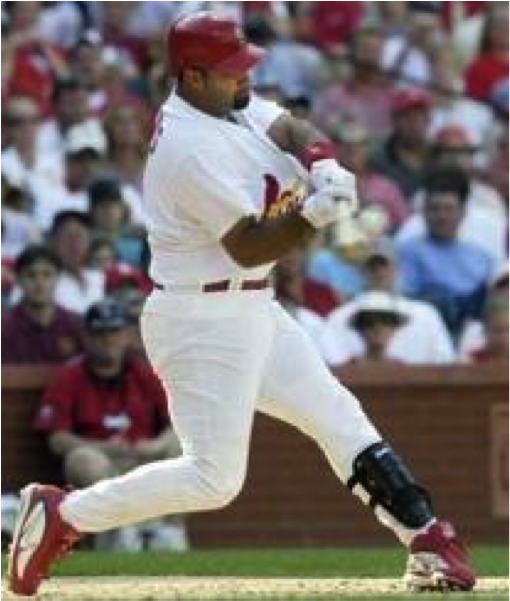
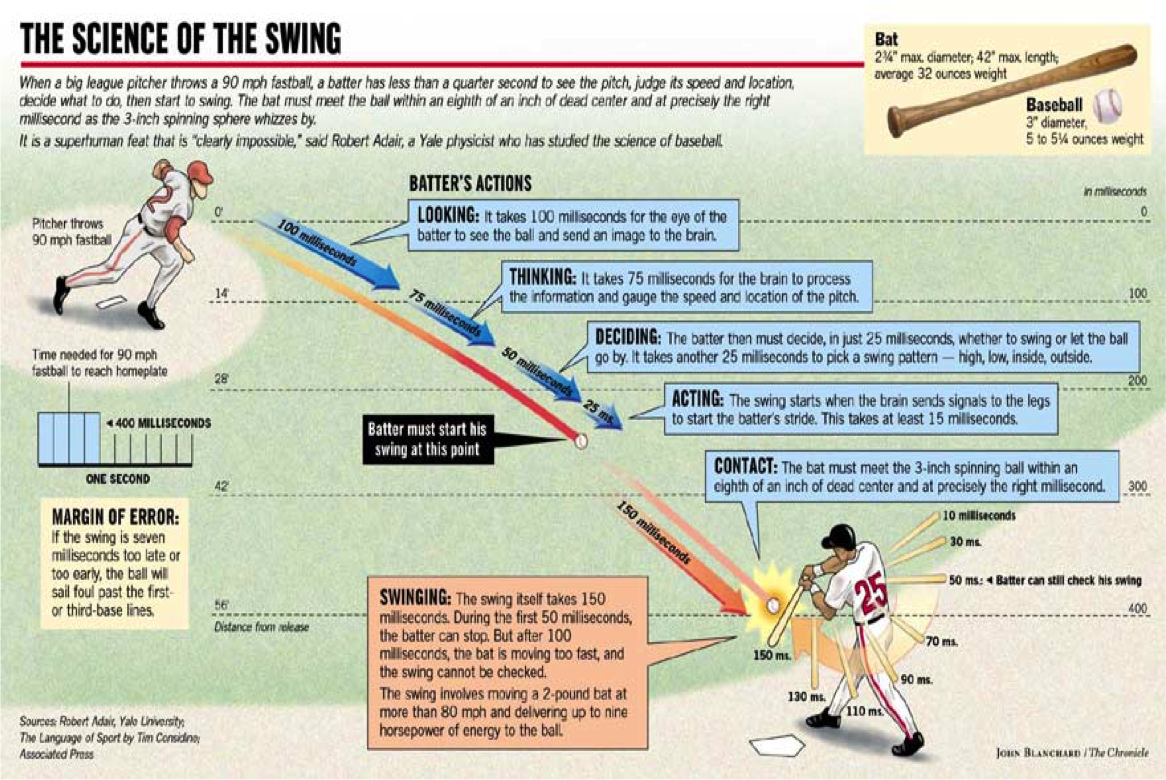
Ideally, every hitter wants to be in Pujols’ position. However, even the great hitters have trouble getting to this position consistently. Further illustrating the difficulties of being on time, let’s consider the physics of baseball. A study performed by Yale professor, Dr. Robert Adair, detailed the amount of time from release point to the plate. A 90 mph pitch will arrive at the plate in 400 milliseconds. During that time a hitter must recognize the pitch type and location and get to astrong contact position.

According to Professor Adair’s illustration, it takes a hitter 150 milliseconds to complete a swing at 80 mph. This leaves the hitter roughly 250 milliseconds to locate the ball, process, decide, and start the swing. Professor Adair’s study helps piece together the physics and how difficult being on time is for a hitter. However, there are other variables that were not included in the study that can disrupt timing for the hitter. Let’s review some of these variables:

• Pitch velocity
• Pitch type (2-seam, 4-seam, change-up, slider, curveball, cutter, splitter, etc)
• Arm speed variability
• Arm angle and release point
• Pitcher’s method of delivery (windup, stretch, slide step, left hand pitcher hang and read, etc)
• Variability of the hitter’s bat velocity
• Situational hitting (hit and run, hitting behind runner at second, sac fly)

Professor Adair’s study does not include human variability. At any time, the pitcher can change his delivery and pitch velocity, which affects the timing aspect of the hitter. Professor Adair’s statistics are of one pitch! Each pitch thrown by a pitcher in a game is unique! It almost seems humanly impossible to be on time consistently. I can guarantee that the best hitters in the game aren’t always on time, yet they still manage to eclipse the .300 average mark. Hitting a baseball now becomes an equation of probability. After all, pitch recognition is a guess! It has been said that hitters lose track of the baseball within 5 feet of the plate….. so now what? Hitting a baseball now becomes an educated guess! You are starting your swing where you THINK the ball will be.

“Great hitters get the barrel on plane earlier and keep the barrel on plane longer than average hitters.”

Keeping the barrel in the bat plane is just as important as having great timing. I have already established that timing isn’t the be-all, end-all for becoming a great hitter. It’s the positions hitters put themselves in when their timing is off that allows for eclipsing the .300 average mark. Touching on a quick side note, I believe that contact percentage is a mark of a great hitter, not just overall batting average. In 1941, Joe DiMaggio set the hit streak record at 56 games, a record that may never be broken. Do you think that a contact percentage of 97% had anything to do with setting the record? I think so, as Joe only struck out 13 times!

Using Video Analysis to Determine Bat Plane 

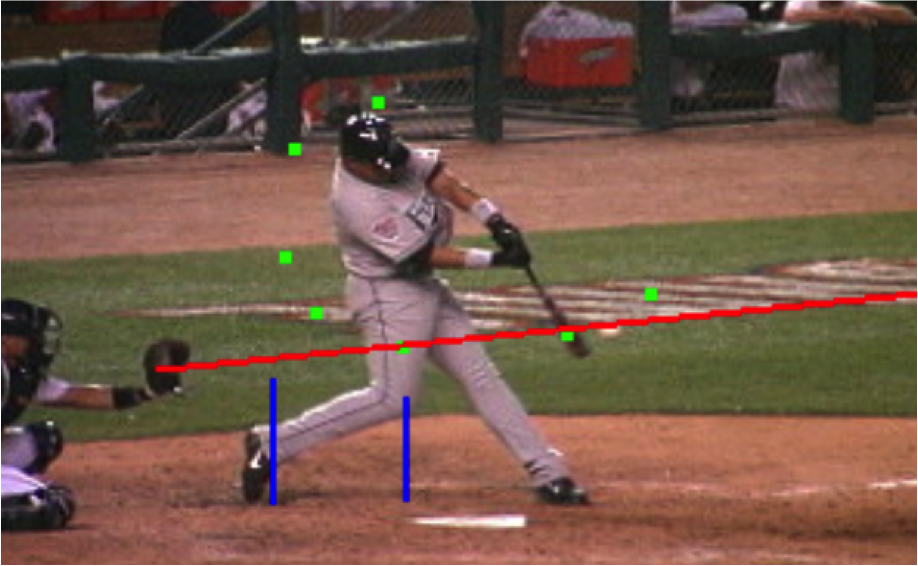
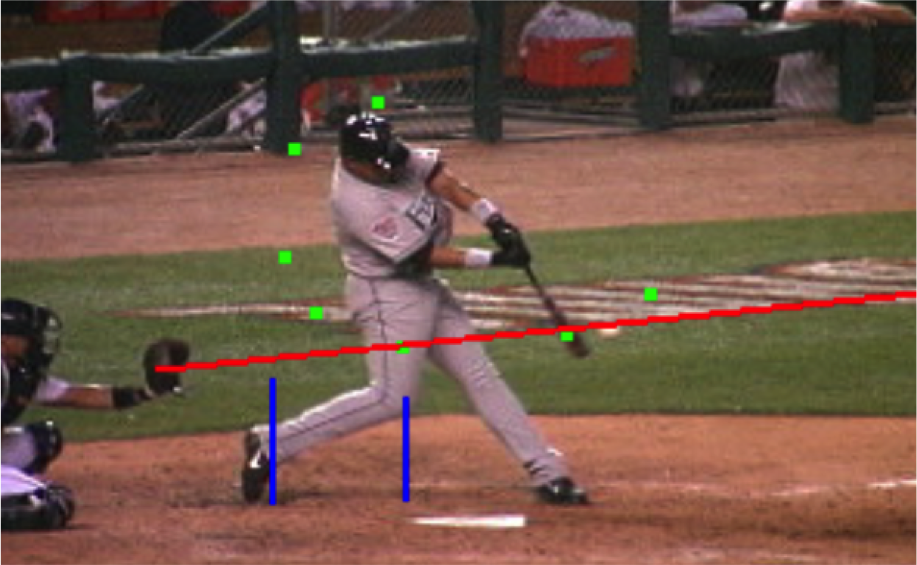
Cressey Performance pitching instructor, Matt Blake, utilizes the Right View Pro system when evaluating mechanics. For the purpose of discussing bat plane I have taken images from RVP to help illustrate the importance of the bat plane and how it relates to timing. The first image we will look at is MLB’s Triple Crown winner, Miguel Cabrera.

*Note: Red = pitch line/bat plane, Blue = distance knee traveled from start to contact, Green = Barrel from start to contact.

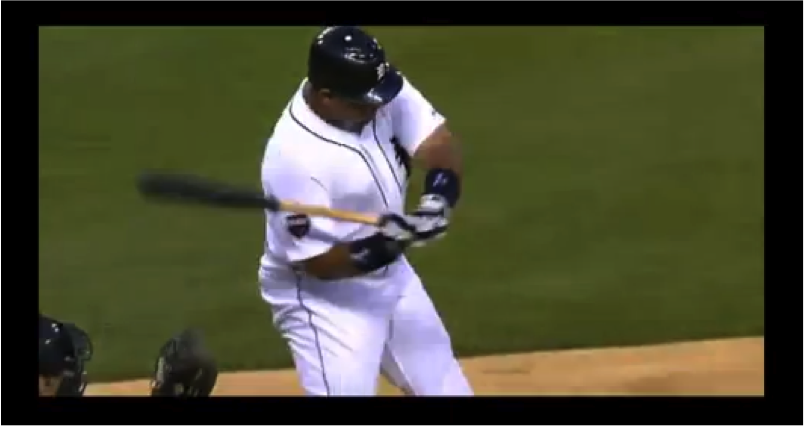
In this image, Cabrera is not in a great point of contact position, but he did great things during his swing to allow himself to stay on the plane. His contact position is out front and he is slightly early, which is why his back elbow is extended. Result? Line drive single to left field. Cabrera was able to maintain a good position to hit because of his ability to keep the barrel in the bat plane past his strongest point of contact. Cabrera’s success is not based off of having perfect timing, but instead putting himself in a position to be successful. So, how does he get the barrel to the plane early and stay through, even past the optimal point of contact? I think this is a question hitting coaches have been trying to figure out for decades. For the sake of keeping this short, let’s examine a few key components.

Early to the Bat Plane

Getting the barrel to the beginning of the bat plane is driven by the back elbow. Upon toe touch and heel plant, Cabrera’s first move is with the hips, which allows for the elbow to get clearance to move directly to the back hip. In being direct with the elbow, Cabrera avoids having an elongated swing.

Optimal Contact Position

A contact position with the back elbow flexed and tucked tightly to the body will allow for optimal power.

Consider the sport of boxing. Great knockout punches are not performed with full extension; rather, the punches land with flexion in the elbow because it is a stronger point of contact. This idea is evident in baseball, too!

Keeping the Barrel in the Bat Plane

Consider Cabrera’s lower body as the key ingredient in keeping the barrel in the bat plane. The distance his back knee travels allows him to keep his barrel in the bat plane, and in this case, past his ideal point of contact. If Cabrera “squishes the bug”, he either rolls over or his barrel is out of the bat plane by the time the ball reaches him. There are other factors that help Cabrera stay in plane, such as elbow extension. However, if we want optimal power, we do not want to have elbow extension to occur before contact. Cabrera’s ability to keep the barrel in the bat plane past the point of contact is what makes him a cut above most major leaguers and the reason he won a Triple Crown. On the flip side, if Cabrera were to be late with his timing, his barrel in this particular swing is in plane starting at the back of the plate; giving him an opportunity to be successful.

Timing is Only a Piece of the Puzzle

Timing is an important component of hitting, but raw hitting mechanics should take precedence over addressing uncontrollable variables against which players compete. In low levels of baseball, players can get away with not being in the bat plane like Cabrera is. Why? A majority of lower level pitchers have one or two pitches they can control, and a majority of strikes are thrown over the heart of the plate. The debate over linear, extension-based, and rotational hitting approaches can be saved for future discussions. Regardless of the hitting philosophy, keeping the barrel in the bat plane before and after optimal contact position increases the probability of making contact with the ball.

References: www.Baseball-Reference.com